WPI — BASHLab research
In-ear multimodal sensing device
Engineering at the frontier
At Worcester Polytechnic Institute, I'm leading the design and development of a wearable medical earbud capable of tracking vital signs with clinical-grade accuracy — all from a discreet, comfortable device worn behind the ear.
The device targets the sensitive region beneath the ear near the jaw — a site identified in recent biomedical research as an exceptionally rich source of physiological data. From this single contact point, the earbud monitors heart rate, respiratory patterns, vocal activity, and motion simultaneously.
The mechanical design, developed in AutoCAD, prioritizes ergonomics and comfort: the housing must be lightweight, anatomically contoured, and robust enough for continuous wear. The embedded firmware, written in C++, processes sensor data in real time and manages power efficiency for extended battery life.
Inside the platform
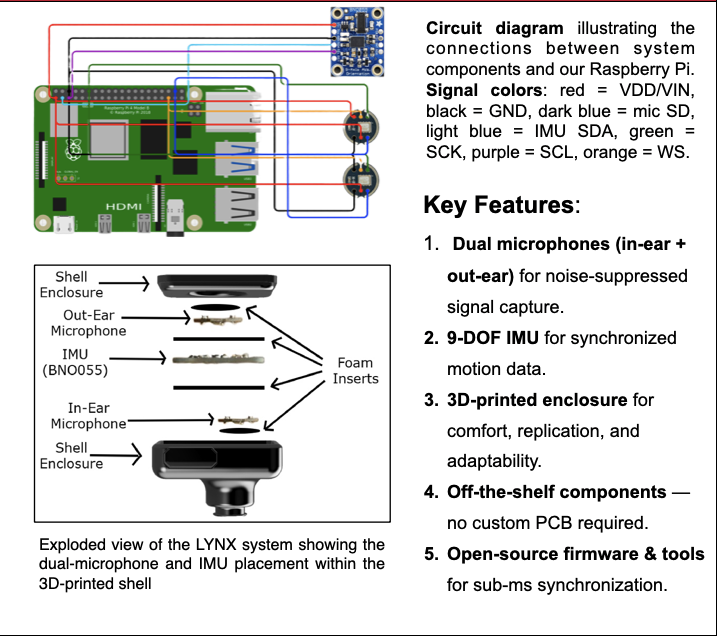
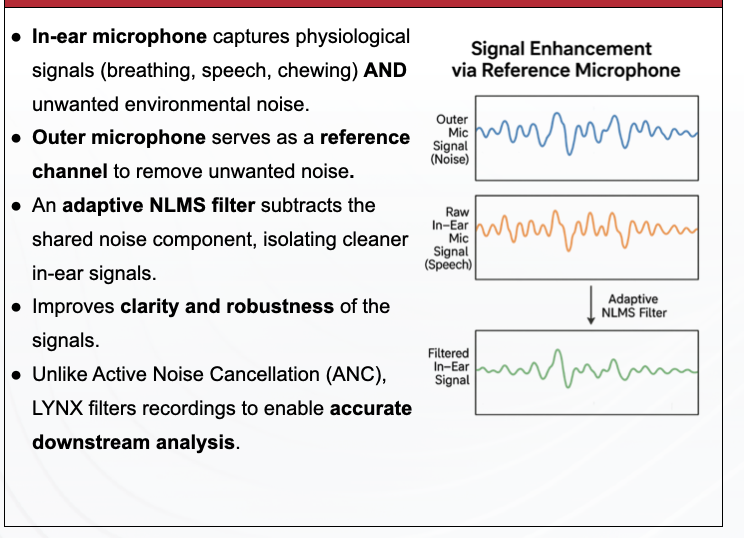
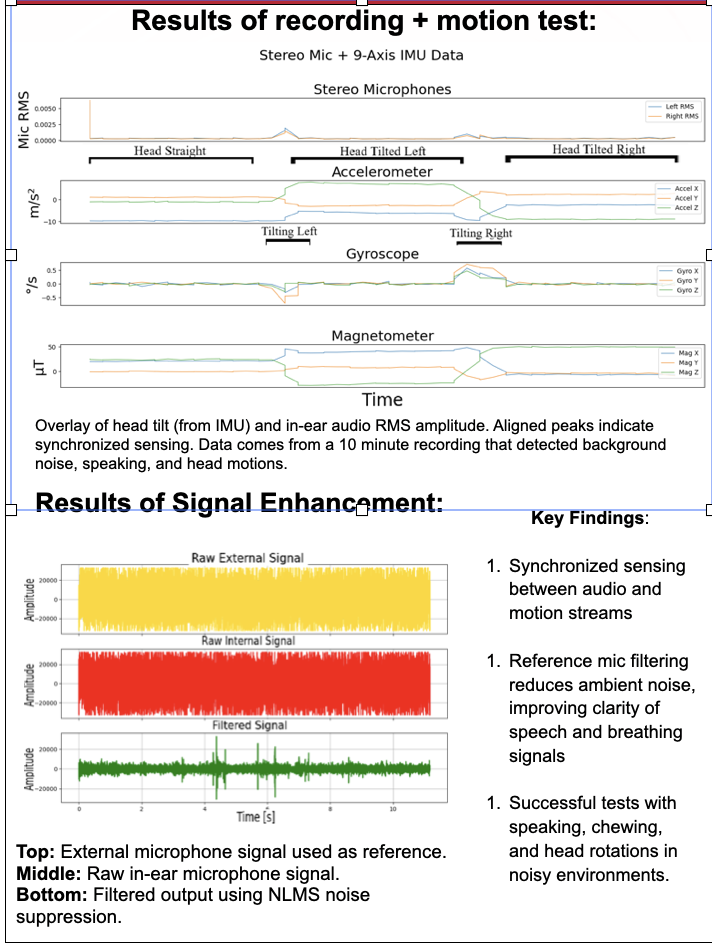
LYNX pairs an in-ear and an out-ear microphone with a 9-DOF IMU in a 3D-printed shell — all off-the-shelf parts, open-source firmware, sub-millisecond synchronization between the audio and motion streams. The out-ear microphone exists to be thrown away: it captures the same ambient noise as the in-ear channel, and an adaptive NLMS filter subtracts it, leaving the physiological signal — breathing, speech, chewing — clean enough for downstream analysis.
Key contributions
- Led the design and development of a wearable medical earbud capable of tracking vital signs including heart rate, respiratory patterns, vocal activity, and motion.
- Identified and targeted the sub-auricular jaw region as the sensing site based on recent physiological research showing its superior data density compared to conventional locations.
- Collaborated with a WPI professor to lead the project from initial concept through functional prototype — managing both the mechanical design (AutoCAD) and embedded programming (C++).
- Designed the device housing for minimal weight, anatomical comfort, and durability under daily-wear conditions.
- Patent filing in progress for the final design; co-authoring a research paper for submission to the MIT Undergraduate Research Technology Conference (URTC).
This project sits at the intersection of mechanical engineering, biomedical sensing, and embedded systems — disciplines I'm merging for the first time at this scale. The goal is a device that doesn't just measure vitals but does so with enough accuracy and comfort to be used continuously in real-world conditions.
Patent filing in progress