Project
- Discipline
- Hardware
- Timeline
- June 2025 to June 2026R&D internship
- Role
- R&D internWorcester Polytechnic Institute (WPI)
- Category
- Medical device engineeringWearable health technology
- Status
- PrototypeCo-authored paper, WPI BASHLab
Tools
- AutoCAD
- C++
- Embedded systems
- Medical device design
- Biosensing
- Prototyping
Overview
At Worcester Polytechnic Institute, I worked on the design and development of a wearable medical earbud.
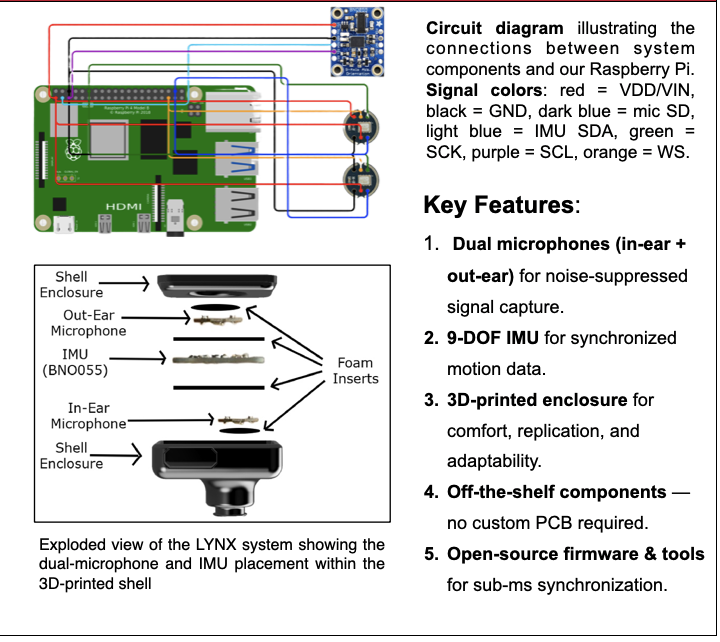
The device targets the region beneath the ear near the jaw, a site shown in recent research to yield rich physiological data. From there, the earbud is designed to capture heart rate, respiration, voice and motion.
I used AutoCAD for the mechanical design and C++ for the embedded code, with a light, comfortable fit as a hard constraint.
Inside the platform
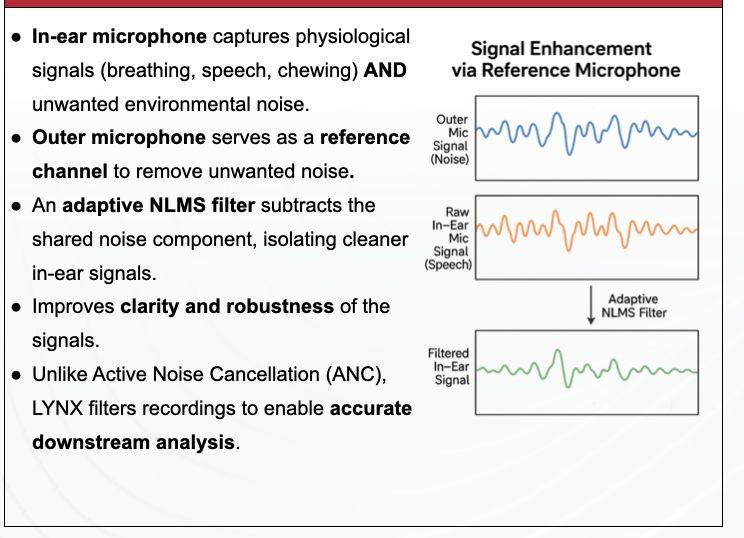
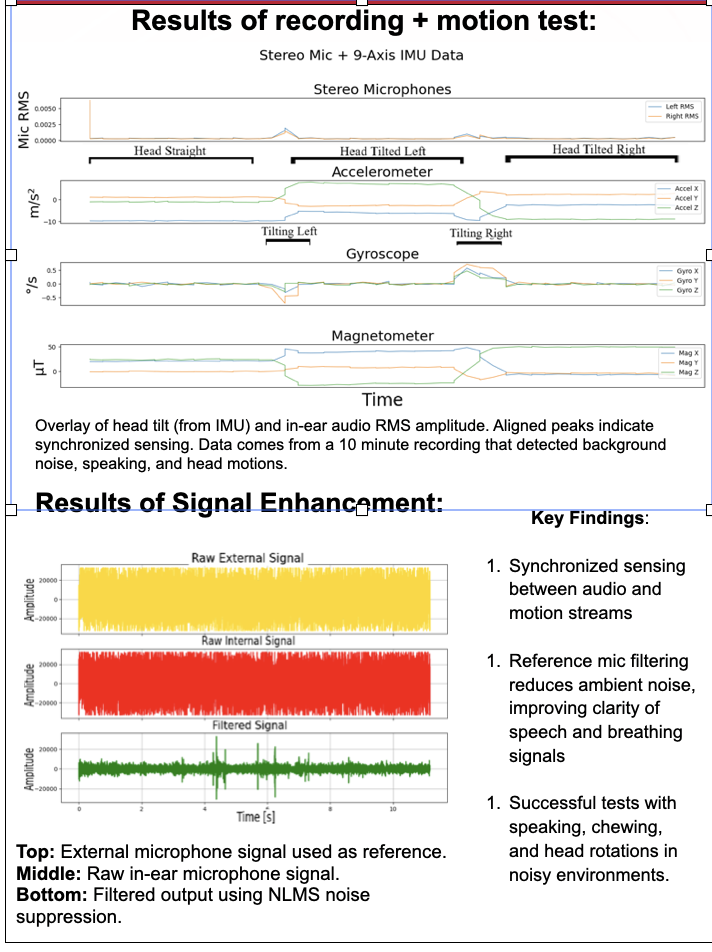
LYNX, the lab's platform, pairs an in-ear and an out-ear microphone with a 9-DOF IMU in a 3D-printed shell — all off-the-shelf parts, open-source firmware, sub-millisecond synchronization between the audio and motion streams. The out-ear microphone is a noise reference: it captures the same ambient noise as the in-ear channel, and an adaptive NLMS filter subtracts it, leaving the physiological signal — breathing, speech, chewing — for downstream analysis.
Key contributions
- Worked on a wearable medical earbud designed to capture heart rate, respiration, voice and motion.
- Worked directly with a WPI professor from concept to prototype: AutoCAD for the mechanical design, C++ for the embedded programming.
- Co-author on the lab's LYNX paper.
Internship ended June 2026